
QUESTION FOR STUDENTS : How long would you work on your computer before you looked for a way to do something different to something fundamental, instead of using the default option that is automatically engaged?

TYPOGRAPHY PROJECT IDEA FOR TEACHERS : Ask students to devise 5 different ways to place a period at the end of a sentence (vertically centered dot, space before the period, new shape, etc.). What context might cause you to do something specific? Try doing this for anything that is generally considered a rule and isolate the best options for consideration.
Another personal observation is the weight of a footnote's number or other symbol within the text; I seldom notice the superscript number while reading the book. Then when I see a footnote which interests me, I have to scan the entire page to find the bit of text it refers to. Shouldn't this be easier?

THE GENERAL BASIS FOR THIS BLOG ENTRY should offer exciting viewpoints for students and teachers. Ray speaking here: I suspect that most designers today, working with computers, don't experiment with certain types of detail, given that the processor applies rules to typography so evenly. But when you are composing with metal type, you run into physical obstacles that cause you to consider options that might not typically come to mind in the digital world.
See blog entry on half-justified type.
A particular letterpress-printed book got us to start thinking more seriously about taking back control of the way we set type. Eric Gill's An Essay on Typography offers a fascinating look at the thought processes of someone with masterful control over his typography. Gill set the type in this small book in a flush left / ragged right style. This was one of the first times text in a book was set unjustified, which in itself seems like a late development in the history of books.
Before movable type was common, scribes often invented contractions to help create justified type. I know that in my writing I tend to try to avoid contractions.
Our particular copy of Eric Gill's classic essay is a first-edition that is "uncut." The printed sheets of the book were gathered in pairs, then folded twice to make signatures of 16 pages each, and never slit open or trimmed across the tops of the pages before being sewn and cased into a hardcover. Consequently, you can only fully open the first and last pages and the center spread of each signature.
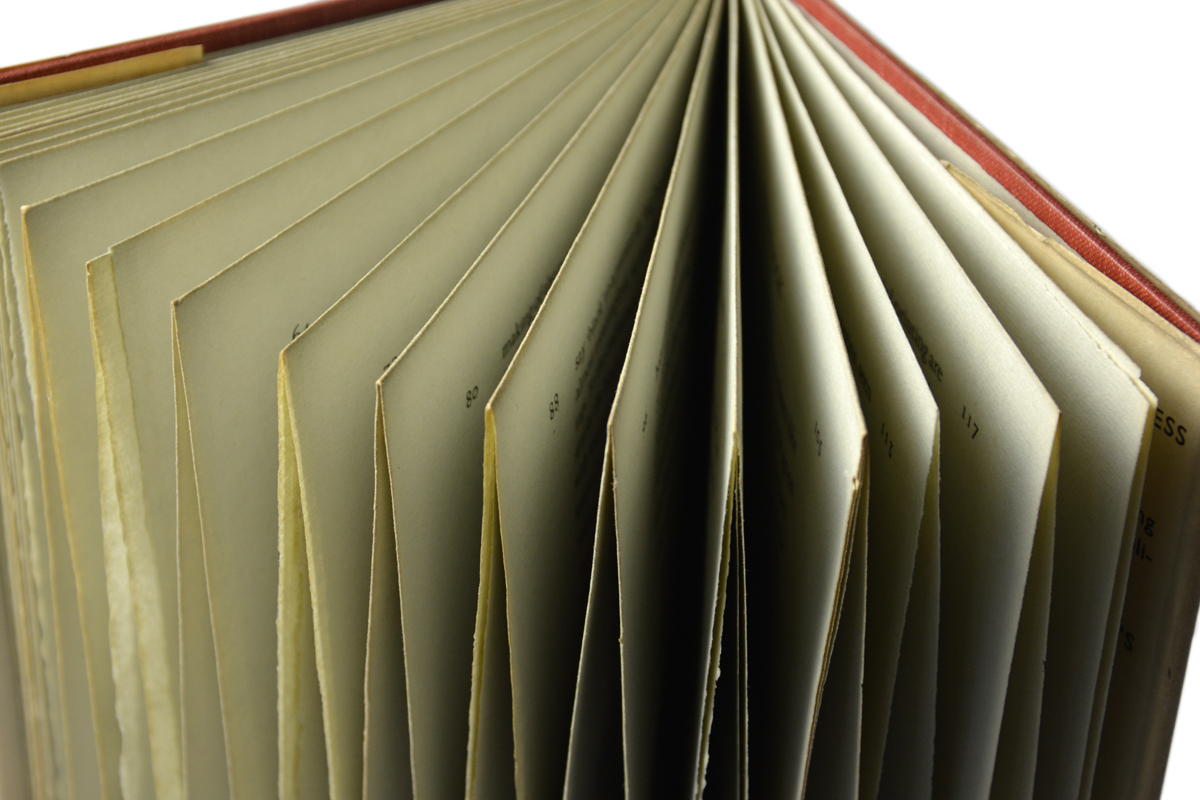
This image shows the uncut (untrimmed) pages.
If you want to avoid becoming a typographic robot, dive deeper into the history of hyphenation and justification by reading Paul Shaw's article "Tiger Rag: Attitudes toward Hyphenation and Rag Settings" for Print Magazine.
Gill's Condensed Words
GILL MADE AN UNUSUAL DECISION in order to maintain a smoother ragged right edge in his page composition. He used smaller, yet not quite superscript-sized, letters to help crowd words onto a line to get as close to justified as he could, without artificially altering the word spacing.
The lines below are taken randomly from the text of Gill's book. They do not connect, so view them individually.


These first two examples condense the letters "tion", one in the middle of the line and one at the end. The smaller type, raised above the main baseline, almost appears to be a superscript.



The 3 examples above are located more in the middle of the line and involve fewer letters. The main idea seems to be to keep the beginning of a word in the larger type to help with readability, while using the smaller sized type for the ends of words to aid spacing.

Above, another example with the condensed letters at the end of the line.

The last example above shows the strangest contraction (to our eyes) where the word "very" is abbreviated "vy." Also note there is no apostrophe, which typically is used to indicate missing letters. The single superscript letter being a Y has the added visual quality of almost reaching the baseline, giving it a graceful balance.
Out of our book's 120 pages, we can actually only easily read about 20 of them because it's pages are uncut. We're looking for another 1st edition to examine it more thoroughly. We happen to have a 4th edition copy, which has an added chapter at the end and does not include any of these unusual typographic features. It also includes quotation marks, which we discuss below.
The full page shown here provides a good idea of how well Gill's condensed words work for establishing visual balance with a gently ragged right edge versus the awkward word spacing usually encountered with justified edges. The red dots indicate lines that have a contraction in them.
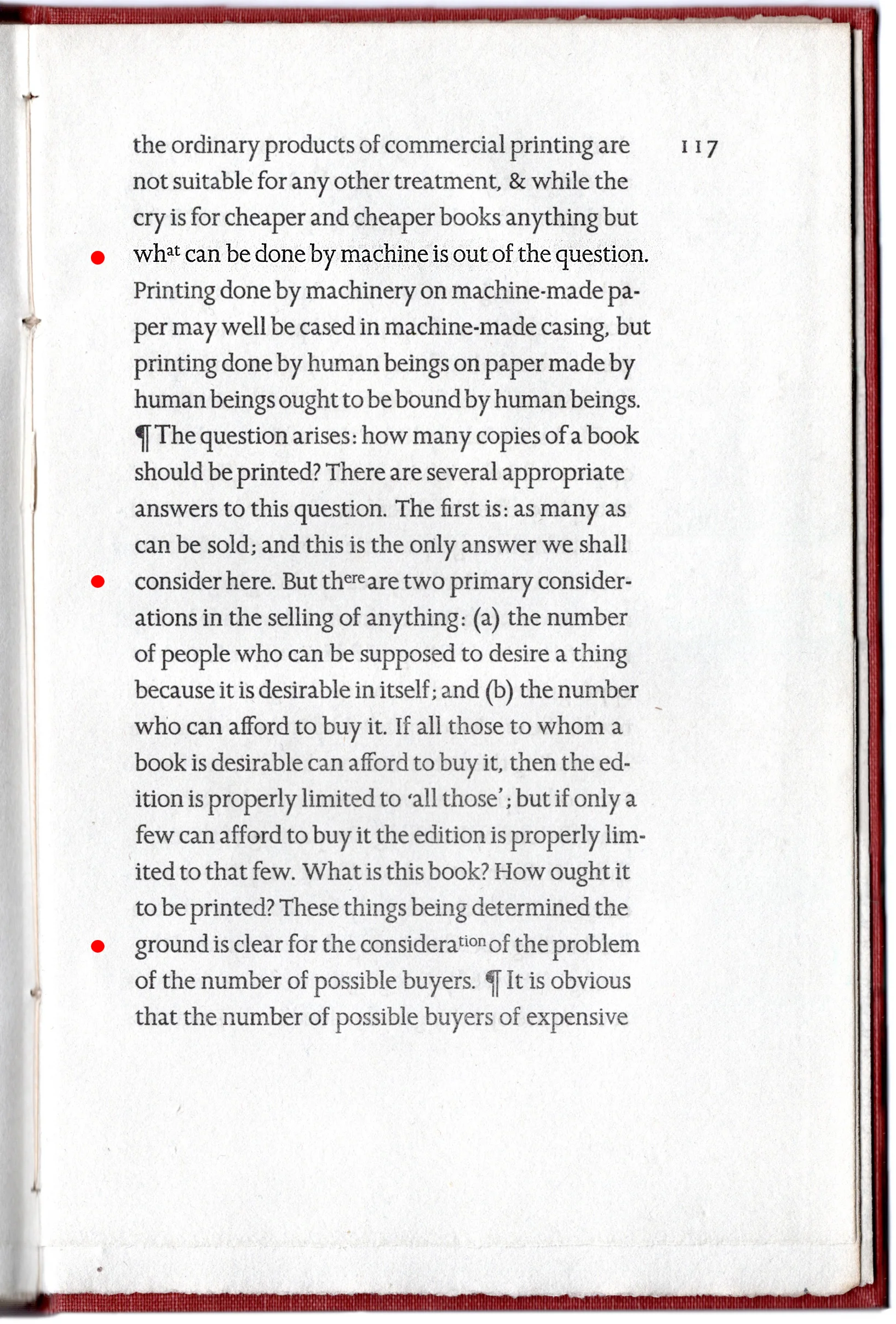
We often remind students to avoid deferring to the default settings that are supplied continuously by the computer. We suspect it takes a great deal of focus on a substantial amount of typography before students feel comfortable experimenting to this degree, offering another example of the typographic genius of Eric Gill.
Gill's Quotation Marks
AS WE'VE GOTTEN DEEPER INTO LETTERPRESS, our research has shown us many things that we like and find curious. One of those things is the different ways punctuation can be used. Yet another example from An Essay on Typography is Gill's use of quotation marks. When using single quotes, Gill positions the first one lower than the second. We like the touch of typographic detail this displays.
We'll need to look for any variations, such as
Does anything change if the word is capitalized?

It would be nice to ask Gill precisely what he is seekng, or is he just experimenting or playing with the single quotes by positioning them at two different levels.

We were wondering what might happen if a word was capitalized, but this example which has an initial letter with an ascender probably answers that question.

This was just an interesting example of two words in such proximity.
An Essay on Typography was the first historically important and expensive book we bought for our collection.